

Yesterday Eli Dourado, an American writer and investor, tweeted this:
I’m sorry, trains are not an abundance technology.
I think many people in the abundance scene like trains because:
1. America’s inability to build H[igh] S[peed] R[ail] is the leading example of low state capacity, and we all more or less agree that state capacity is a tenet of the abundance agenda.
2. Trains have high transport efficiency, and people coming to abundance out of the climate movement can’t shake their old habits of caring about energy efficiency ahead of other considerations.
Obviously if we spend billions of dollars on high-speed rail, there should at least be some high-speed rail service. But a deeper element of state capacity is not picking dumb things for the state to build in the first place. And trains are a dumb thing to build in the 21st century.
A true transportation abundance agenda has to revolve around airplanes and autonomous vehicles. The goal should be able to go from any point in the country to any other point in the country in, like, two hours, door to door.
We should have supersonic airplanes made out of cheap titanium and powered by electro-LCH4. An autonomous vehicle should be available to pick you up within 30 seconds and whisk you to a nearby airfield. Security should be painless and instant (another state capacity task). If your trip doesn’t require an airplane, the autonomous vehicle should get you straight there at 100+ mph since it’s good at avoiding accidents. In cities, autonomous buses with dynamic route planning based on riders’ actual needs beat subways’ 1-dimensional tracks.
We should not be trying to build marginally better versions of 20th century (or 19th century!) technology. We should be more ambitious than that. Trains are unbefitting of a country as wealthy as I aspire for us to be.
Please join the anti-train faction of the abundance movement.
For those who are unfamiliar, the Abundance movement (which also goes by the name of Progress Studies) is the name for a broad coalition on both sides of the Atlantic that wants to improve the world by ending economic and technological stagnation. In practice, this means we want to build more things (chiefly housing and infrastructure), improve the ability of the state to get things done, and accelerate the rate of technological progress.
I am proudly in the pro-train faction of the Abundance movement. I think Eli Dourado is completely wrong to be so dismissive of rail, even in the American context in which he is writing.
Space efficiency, not energy efficiency
Trains have high transport efficiency, and people coming to abundance out of the climate movement can’t shake their old habits of caring about energy efficiency ahead of other considerations.
Why shouldn’t we care about energy efficiency? Dourado is alluding to the goal of energy ‘too cheap to meter’, chiefly by building vast amounts of nuclear power. If we can achieve this, then caring about energy efficiency is essentially redundant. We will have so much energy that it doesn’t matter any more.
For what it’s worth, I completely support this goal. But the reason why trains are efficient is not just to do with energy. It’s to do with space, which is something that unfortunately is inherently limited.
The capacity of a modern high-capacity metro line like the Victoria Line or Line 14 of the Paris Métro is well over 35,000 passengers per hour per direction (pphpd). The Tokaido Shinkansen high-speed line between Tokyo and Osaka can move 21,000 pphpd.
A lane of motorway carries 2,160 pphpd, and a single carriageway road is about 600 pphpd. A track of rail carries an order of magnitude more people than a lane of road – and even if autonomous cars are able to travel a bit closer together, they will not be able to make up the difference.
Railways are obviously not a free lunch. The downside is that they have high fixed costs. Building a new railway line can be incredibly expensive, even in a country like Spain that has low construction costs: it’s not just about carving out a right-of-way, as we do for a road, but also laying the tracks, signalling systems and electrification. Operating trains also has high fixed costs. This means that railways are not viable everywhere: in rural areas, say, they need a subsidy to cover their losses.
But thankfully, we have already done a lot of the work already. Nearly every European country already has a pretty big railway network and the same is true of many places in America. Boston, New York, Philadelphia and Chicago have impressive railway networks. The Sun Belt has less, but it would be wrong to think that it is a railway-free zone: Charlotte, NC has eight lines going through its suburbs.
In many cases these lines do not offer passengers a particularly good service. That means they need to be transformed into a modern rapid-transit network.
In North America, this means first getting the basics right: electrified tracks, using multiple-unit trains, increasing speeds, separating freight from passenger trains, and modern scheduling practices.
In Britain, France (outside of Paris), and most former Eastern Bloc countries, this means through running: digging short lengths of tunnel so trains can run through the city centre, rather than having to terminate on its edge. Tram-trains are another way of doing this in smaller cities. America should also do this, but it first needs to get the basics right.
In Paris and the German-speaking world, there are already through-running networks, and but in some cases they’re not as extensive as they could be.
In Switzerland and Japan it just means carrying on doing what they are doing.
Dourado says that “a deeper element of state capacity is not picking dumb things for the state to build in the first place.” I would add: state capacity is also about making sure we use our existing assets as efficiently as we can. America and Britain have inherited from our Victorian ancestors a vast railway network; squandering this would be foolish in the utmost.
Railways and cities
Because railways are more space-efficient, they can go straight into city centres without having to tear down the urban fabric to build roads.
For me, abundance means building good cities. Good cities are places where people want to be – which means walkability, a reasonable degree of density, and beautiful architecture. And good cities are places that are rich – which requires easy mobility on a high-capacity transport network, so that people can easily get to jobs and amenities.
The great megacities of the free world – New York, London, Paris, Tokyo, Osaka, Seoul – have many differences in their urban make-up, and all have their flaws, but they share one thing in common: they are rail cities. The same goes for their smaller counterparts, like Madrid, Munich and Copenhagen.
It would be simply impossible for these places to have good urbanism and to be rich without railways forming the load-bearing part of their transport network. To put the point visually:
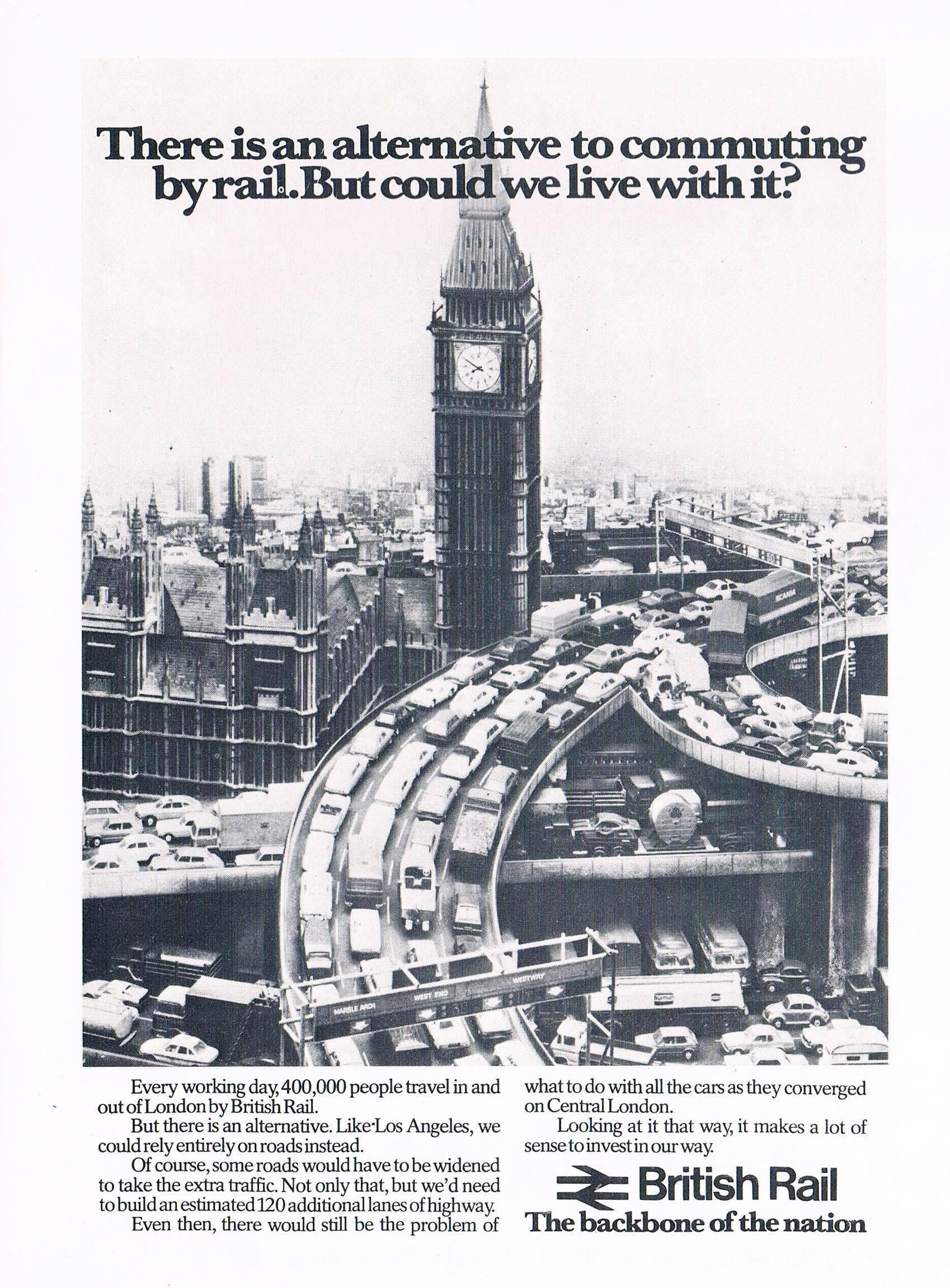
(What about underground roads? They are a good idea in principle, but they still suffer from the same problem as ordinary roads: a road tunnel has much lower capacity than a rail tunnel. They’re sensible in the outskirts, but not in city centres.)
I don’t oppose roads. There are many trips for which railways will never work. But when it comes to journeys to the centres of big rich cities, into which hundreds of thousands of people travel each day, railways are the only viable option.
Bionic duckweed
But I think the crux of Dourado’s argument is: We shouldn’t invest in rail, because a better technology might be just around the corner.
This is what Stian Westlake calls ‘bionic duckweed’. The term comes from an amusing exchange in the British Parliament regarding railway electrification in 2008. The government had recently published a White Paper saying that we shouldn’t electrify more railway lines, because other sources of power like hydrogen or ‘bio-diesel’ might come onstream. Railway expert Roger Ford characterised this argument as:
because we might have fuel cell power trains using hydrogen developed from bionic duckweed in 15 years’ time … we might have to take the wires down and it would all be wasted.
In other words, bionic duckweed involves refusing to invest in a technology that we know works today in the hope that, per Mr Micawber, something better will turn up.
America (and to a lesser extent Britain) is very far behind the technological frontier when it comes to transport. It should see itself as a developing country, which means it should learn from what the transport-developed world does right. America should be trying to copy Japanese high-speed rail, Swiss timetabling, and German subways. Just copy and paste it. Don’t try to innovate, the rest of the world has done that already for you.
Doing otherwise would be profoundly risky. The obvious problem is: What if the bionic duckweed doesn’t turn up, or is a disappointment when it does arrive?
We shouldn’t let the perfect be the enemy of the good – or, in this case, let utopia be the enemy of the good. It is tempting to sound sage and sensible by saying ‘let’s make sure we get this right so we don’t regret it later’, but like many wise-sounding statements, this statement is only as strong as its weakest assumption. We should not have blind faith in our ability to create utopia.
But let’s take Dourado’s argument at its highest. Suppose that by some miracle America invests heavily in rail. It builds a high-speed rail network like the one shown below. It builds new subways. It upgrades its pre-existing lines into proper regional rail networks.
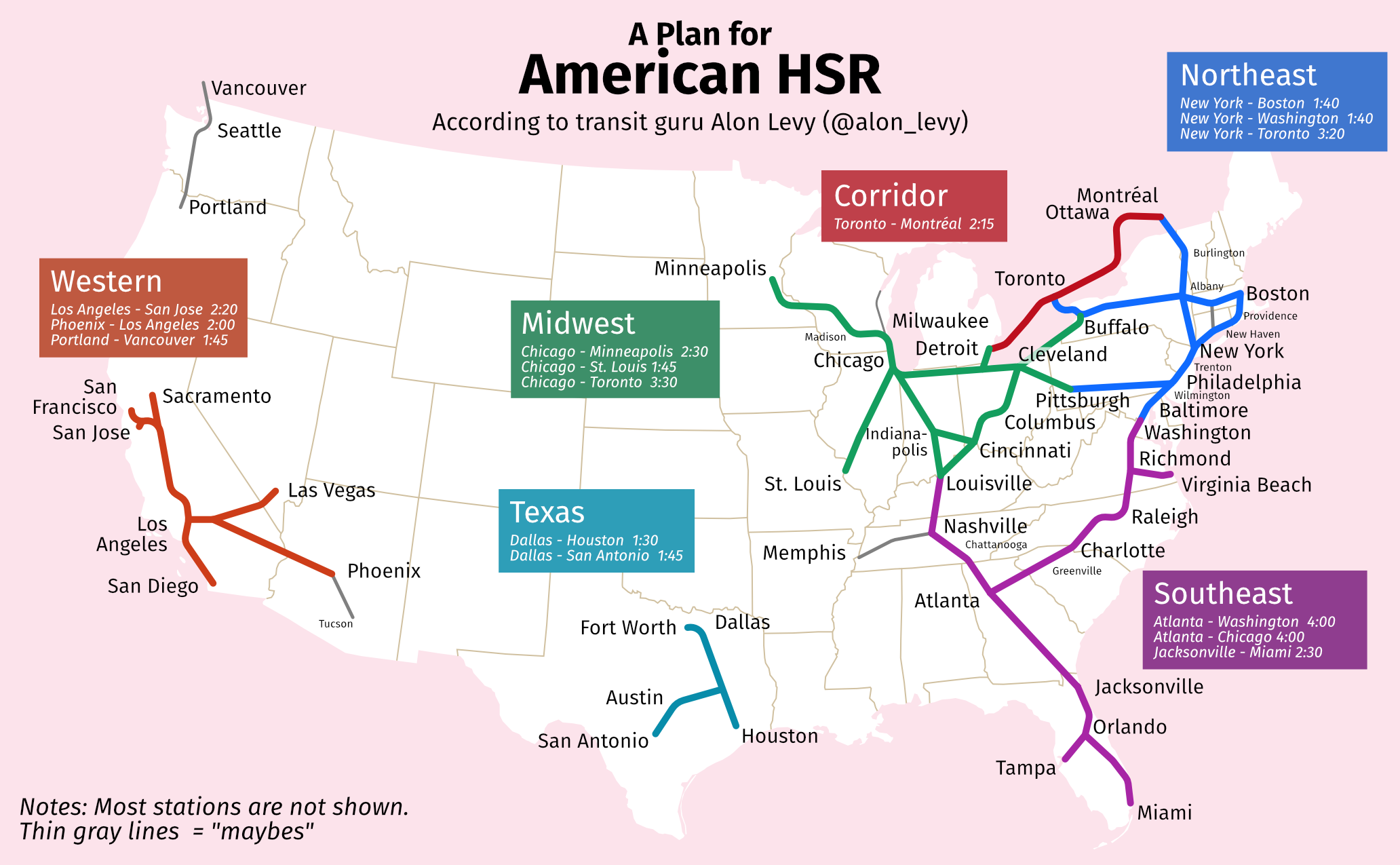
Will this all be wasted if the new technology does turn up and actually fulfils its promise?
Almost certainly not. Dourado says that “The goal should be able to go from any point in the country to any other point in the country in, like, two hours, door to door.” That is a worthy goal. And trains will absolutely be part of that.
What will be the most space-efficient way of getting from the city centre to the airfield where the supersonic plane takes off? A train. What will be the quickest way of getting between the centre of New York to the centre of Philadelphia? A high-speed train, because you don’t need to go to an airfield on the outskirts of the city. What will be the easiest way to commute from the suburbs into the centre of Chicago? A train, not the dreadful American-style ‘commuter rail’, but an express regional rail network, like the network that Seoul is currently building.
I have nothing against self-driving cars and supersonic aircraft. But there will still be a niche for rail. If we do find our way to the prophesied El Dourado, it should be a place which takes an ‘all of the above’ approach to transport. Let walking, cycling, autonomous cars, subways, high-speed rail, coaches, buses, trams, subsonic and supersonic aircraft all compete with one another. They will soon enough find their niches. We shouldn’t decide ‘the future is going to definitely look like this, let’s plan around it and not hedge our bets’ – precisely the mistake made by some of the cars-and-jets enthusiasts of the 1950s and 60s.
Against parochialism
Most Americans have never seen a good railway network. The subways in America’s great transit cities are in a permanent state of crisis, and even when they are running properly they are inferior even to the worse systems in Europe. American long-distance rail is virtually non-existent, except for the Acela between Boston and Washington DC, which is poor even by British standards. Nowhere in America has good trains.
Perhaps this is why Dourado makes the following statement:
We should not be trying to build marginally better versions of 20th century (or 19th century!) technology. We should be more ambitious than that. Trains are unbefitting of a country as wealthy as I aspire for us to be.
(Isn’t every advancement in road transport a marginally better version of a Roman technology?)
We shouldn’t underestimate the extent to which people’s attitudes towards technology are dictated by aesthetic judgements. For the most part, American railways do not have good aesthetics. The subways are unclean and can feel unsafe, and the trains with their corrugated-iron panels look like Anderson shelters. Commuter rail is often powered by diesel. Intercity rail is usually a tourist experience.
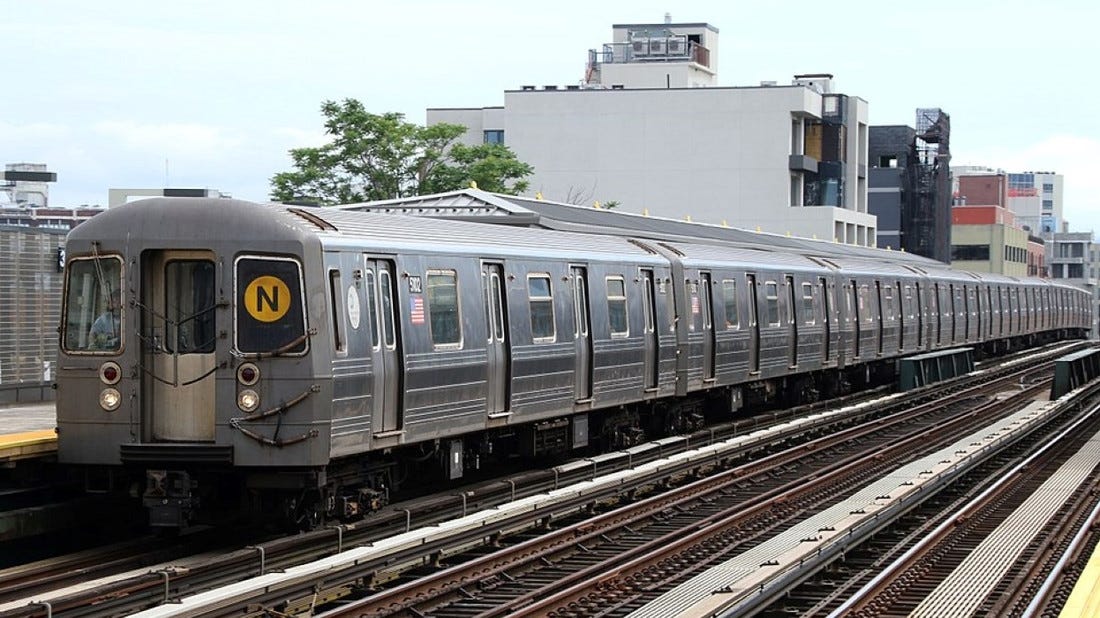
If this is all you have experienced of trains, then it is understandable you would have an instinctively negative view of rail. The New York City Subway does feel very 20th century. Excluding trains from your vision of a better future for humanity seems natural: they are a relic of the past.
Perhaps this is why Dourado uses the adjective “unbefitting”, which would otherwise be a strange choice of word. There is a certain poverty attached to the image of American trains.
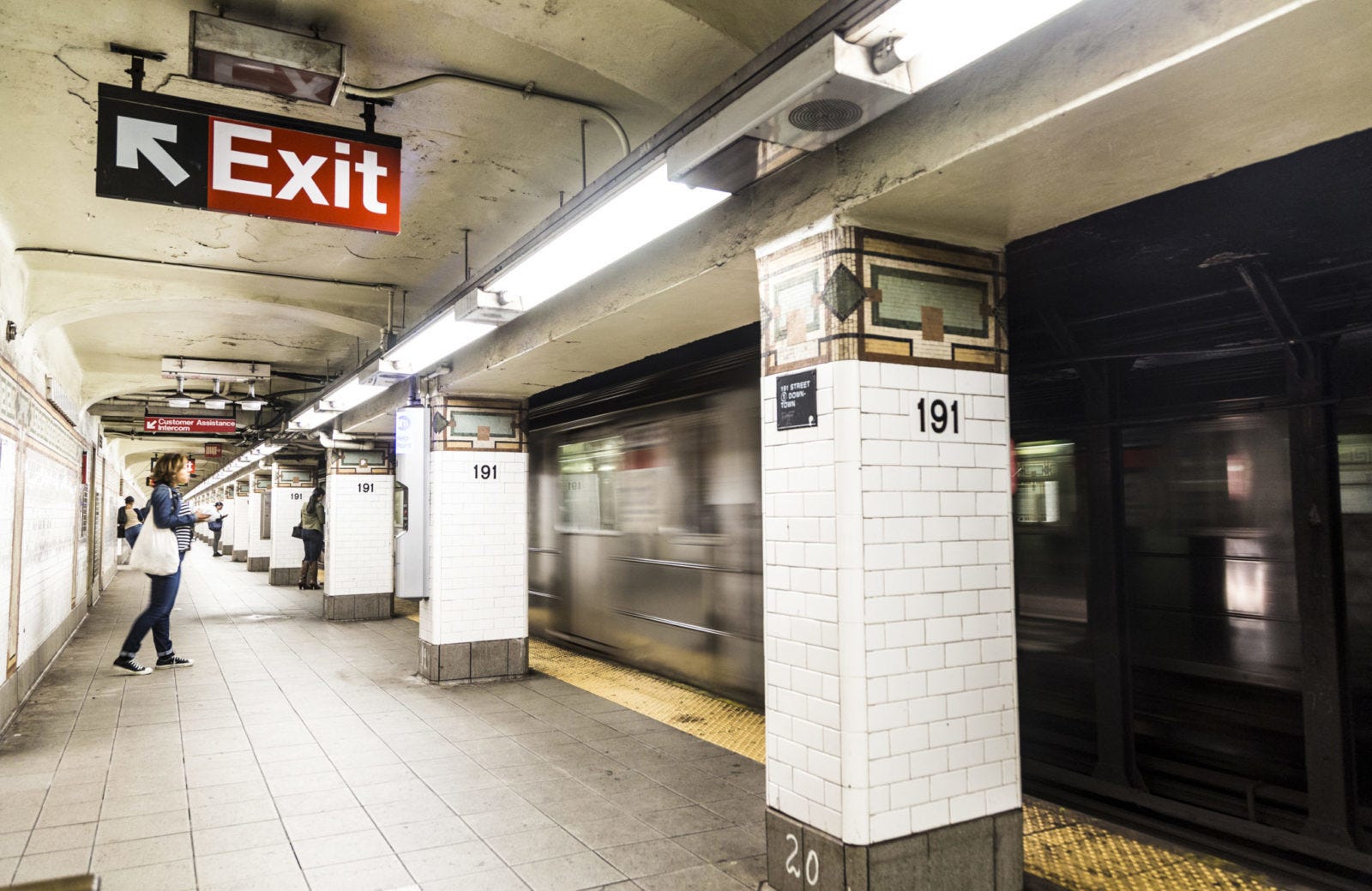
But, as somebody who lives in Europe, I know that things do not need to be like this. Even in Britain, which is hardly a model for the rest of the world, our trains are an order of magnitude better than America’s. However much we grumble they are generally clean, safe, comfortable, and often quite fast and modern.
And in countries with better railway networks, they most certainly do have an aesthetic of modernity and progress. I simply cannot imagine Dourado assuming that there is no place for trains in his technological utopia if he came from France or Switzerland or Spain.
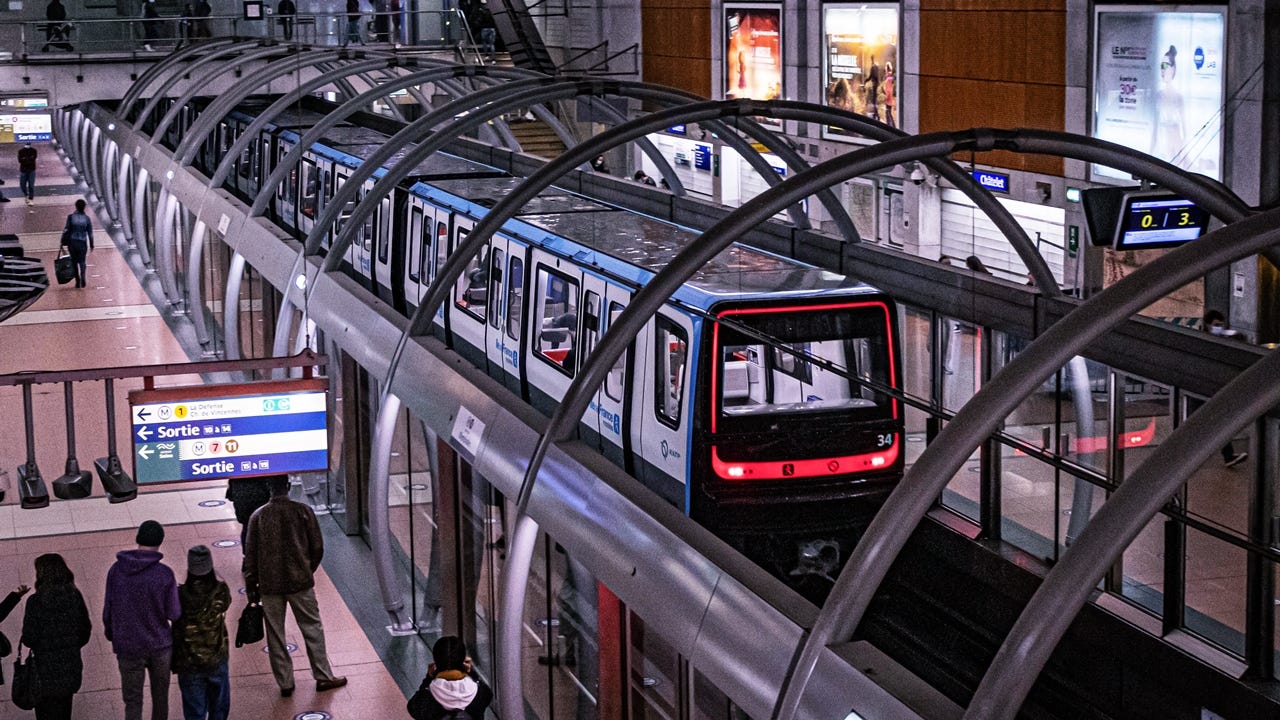

Everybody who wishes to improve their country should be curious about what happens beyond its shores. There are many things that Europe and East Asia get wrong compared with America. But trains are something they absolutely get right. The rest of the world should learn from them.
HSR discourse and its consequences.
How can anglosphere discussion be re-oriented around U/S-bahns and metros, the way it is in this little progress studies bubble? Seems like an uphill battle, especially in CA. A few theories as to why:
- US rail is bad, but BART in particular seems almost custom-designed to act as a strawman of what these systems can be.
- CA HSR also feels designed in a lab to be a punching bag for tech people.
- "great founder theory" or "individual contributor" mindset discounts agglomeration.
- Disdain in some circles for the intangible economy/overcorrection toward reindustrialization.
- CA YIMBY types focus on permitting because BART, for all its problems, is way ahead of densification in SF.
- Obviously HSR is just cooler and there's the China angle (but they did this with metros too and I see much less mention of this outside transit-focused circles).
Also, I think the charitable reading of Dourado is that he thinks bionic duckweed is more realistic than California governments actually delivering anything. The premise being that the Abundance is impossible/naive, so the only way is to go around.
The ‘don’t spend any more on old tech as there is new tech round the corner’ reminds me a bit of Labour 97-2010 not electrifying any railway as they thought hydrogen trains were coming!