
Links for November
PhDs, Princess Diana, and Progress.

Before I begin, it would be remiss of me (given that I have written for them) not to advertise a subscription to the Works In Progress print issue. For just £75 a year, you get six copies of a beautiful magazine posted to you. And sometimes it will contain things that I’ve written.
Links
Although I have quite a Tiggerish personality, the tone of my links posts is usually more Eeyoreish, and this one is even more depressing than usual. But I’ll start with some unambiguously good news.
It’s remarkable that we’ve had the solution to climate change since the 1950s, and then proceeded to regulate it out of existence. If the government implements the recommendations of the Fingleton Report in full (as Keir Starmer has pledged to do), it should get us building more nuclear power stations, and build them cheaper. The Centre for British Progress has created a dashboard to track the government’s progress on each recommendation.
I have recently been trying to get my head around environmental law. Most of it originates in EU law, which means I can use the great research by the guys at Progress Ireland. Ireland, like Britain, has the habit of gold-plating EU law, but that’s not the only problem: the actual text of the EU Directives is a problem. Ecologists don’t much like it either: environmental law focuses too much on expensive, site-specific mitigations (bat tunnels!) and not on the big picture. It feels like there is a great opportunity for Britain to create a win-win system, that more effectively protects nature and doesn’t get in the way of building.
Progress Ireland have been on a roll recently. As well as their work on environmental law, they have done an article about enabling academics to become entrepreneurs: the current system, whereby patents created by academics working at a university are owned by the university, does not work and holds back innovation.
They have also done one of the best articles on the British planning system I’ve read. Yes, it’s about the Irish planning system, but because of Ireland’s tendency to copy all of the bad things from Britain, the two are conceptually very similar. And very different from the American zoning system, which confused an American housing activist:
I explained to [Sonja] Trauss that in Ireland, this isn’t how things work: you can’t legalise housing. You can’t legalise tall apartments beside train stations, for example, because they’re not illegal. There is no rule banning tall apartment buildings beside train stations.
But, as we know, in Ireland, there are almost no tall apartment buildings beside train stations. That’s because it’s illegal to build without planning permission, and the planning system very rarely allows them.
At this point, Trauss looked confused: “So In Ireland, apartments are neither allowed or banned?”
“That’s correct.”
More on housing: some of the technocratic tweaks Labour could implement to make cities denser. And, shockingly, I’d not seen YIMBY Alliance’s map of where housing shortages are most severe.
Rachel Reeves is caught in Zugzwang, a chess term for when every possible move will make your position worse. The only possible defence of Reeves is that she is substantially less bad than the alternatives, so I am very worried by the recent jitters within Labour.
Oh, and the COVID inquiry is dysfunctional. However, Britain’s state failure could be worse:
In New York, a hiring manager can’t just pick the closest job title and description and hire someone using it. And an applicant can’t just apply for an open job that interests them. A central hiring authority periodically conducts exams for some of these 3000 different positions, and applicants interested in that position must take the exam when it is offered if they want to be eligible. For example, one of the positions is Administrative Business Promotions Coordinator. If, as an applicant, you think you may one day want to be an Administrative Business Promotions Coordinator in any agency or department anywhere in the City or State of New York, you must watch for when that exam is administered and spend $85 of your own money to take the exam. If your life goal is to work on transportation, or the environment, or public health, and you don’t know exactly what job title you would need to hold, you’re out of luck, because you can’t apply for a specific agency like the Department of Transportation, only for these generic and often murky job descriptions that may (or may not) qualify you for a job that comes up under that position description anywhere in government in the future.
Britain was once one of the world’s great shipbuilding nations. Brian Potter explains how we lost this industry. It is a story of an industry failing to modernise, losing its competitive edge, generating endless government reports and little action.
On a less depressing note, the Transit Costs Project have a microsite explaining how to build high-speed rail between Boston, NYC, Philadelphia, and Washington.
Do you want to annoy your friends who are doing a PhD and won’t shut up about it? Send them ‘PhDs are easy’. (To be clear, the claim is that getting the PhD is pretty straightforward – it’s almost unheard of to fail – but not that the practice of science is easy.)
To get off your phone, set it to greyscale, and set up an automation to switch back to colour automatically whenever the Photos app is opened. This has done me a power of good.
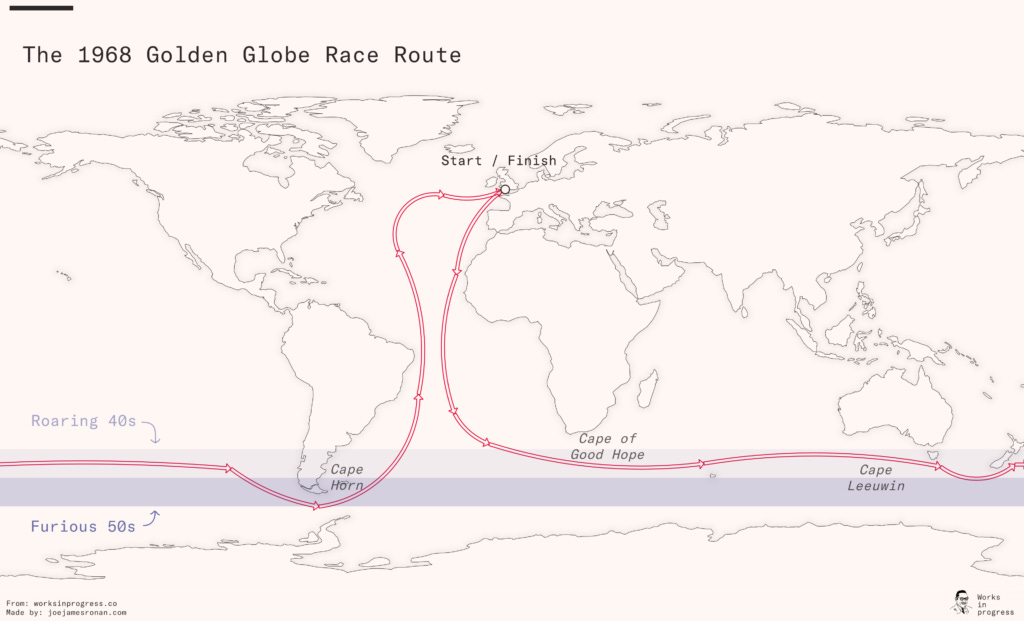
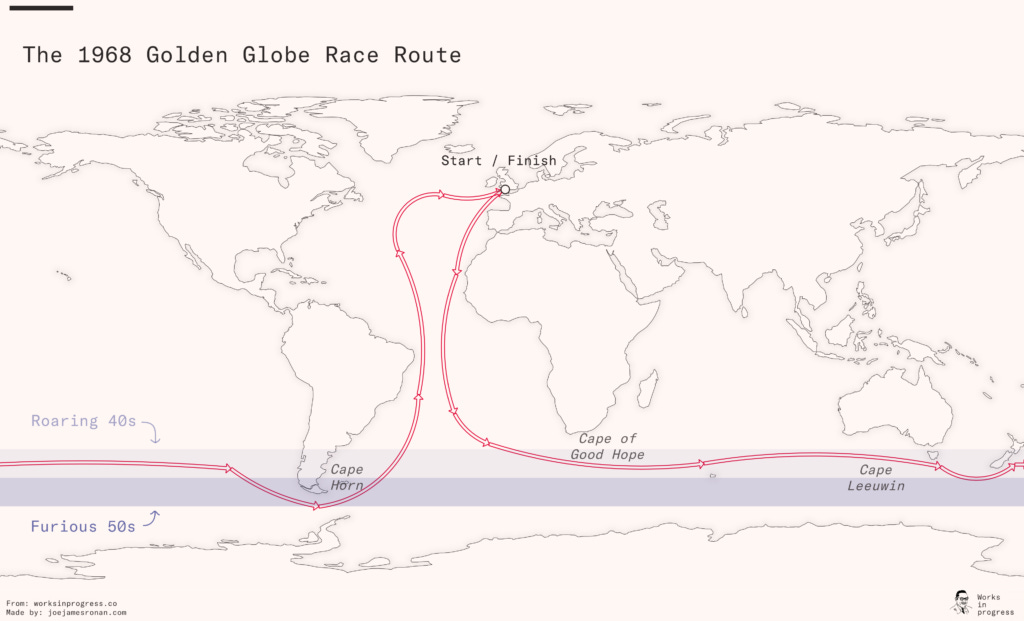
I’ve read most Works In Progress articles, but surprisingly had never read one of the best pieces in the magazine: ‘The Maintenance Race’, about the 1968 contest for the first person to sail around the world single-handed. This was an immense challenge: hundreds of days at sea, much of it spent in the south seas where there is almost no land. And it required enormous amounts of maintenance.
Bentham’s Bulldog confirms my suspicions about continental philosophy: continentals are incapable of arguing. Working out what they mean is impossible because of the verbal thicket that you have to make your way through. This is from Derrida:
The epoch of the logos thus debases writing considered as mediation of mediation and as a fall) into the exteriority of meaning. To this epoch belongs the difference between signified and signifier, or at least the strange separation of their “parallelism,” and the exteriority, however extenuated, of the one to the other. This appurtenance is organized and hierarchized in a history. The difference between signified and signifier belongs in a profound and implicit way to the totality of the great epoch covered by the history of metaphysics, and in a more explicit and more systematically articulated way to the narrower epoch of Christian creationism and infinitism when these appropriate the resources of Greek conceptuality.
You could spend hours playing around with these animated timelines of the development of transit networks. But let’s not forget about the airport people movers, the Cinderella of public transport.
Apparently 248 people board the bus at my stop every day.

I have previously written about Breakneck, Dan Wang’s book that looks at America and China through the paradigm of ‘engineering state vs lawyerly society’. It’s clearly an imperfect simplification, as many have said. But I agree with this review: the best interpretation is Straussian, in that the book (not very subtly, in my view) is a book about America, specifically saying that the American elite should reimagine themselves as builders. Tanner Greer wrote on a similar theme about the last time the American elite were like this. And I had reason to revisit Andrew Bennett’s ‘Sovereign Albion’, which is on a similar theme.
Finally, returning to Eeyore: I was sent this article about Hammersmith Bridge by no fewer than six people. My friends know me well. The bridge, which has been closed to vehicle traffic for six and a half years following squabbling between different bits of government over who will pay for its renovation, cannot be demolished for heritage reasons. That’s fine, but I am astounded by how ugly the proposed solution recommended by the council is. In a manner redolent of environmental law, Britain’s approach to protecting its heritage is so often skin-deep, pleasing nobody while driving up costs.


Books
Off The Rails: The Inside Story of HS2 by Sally Gimson. This is the first book to be written about HS2, and it won’t be the last. I hope that the rest are better. There is some interesting stuff in there, but it is imbalanced. It spends far too many words giving a blow-by-blow account of the events leading up to the cancellation of Phase 2, and the history of high-speed rail in general.
It is much more interesting and useful to dissect what HS2 says about state failure in general, and why it costs so much (Hint: it’s not just about the Bat Tunnel). There is an urgent need to get a better picture on infrastructure costs in Britain. The book does not spend nearly enough time on this.
Gimson also makes several basic errors about things that aren’t HS2, which of course makes me doubt the veracity of the substantive content. France did not, for instance, have an emperor in 1832 (p 29). And two pages later there is the quotation, “Until the advent of high-speed rail in 1991, long-distance cross-country railway routes in Germany still carried echoes from [the Holocaust]” which is perplexing not least because many long-distance trains still run on the legacy alignments. Perhaps invoking the spirit of Adolf Eichmann is an attempt to psy-op the Germans into building a proper high-speed rail network.
A more interesting book was Stubborn Attachments by Tyler Cowen. Cowen makes the moral case for economic growth in the long term. Why should we care about growth? Because what he calls ‘wealth plus’ (i.e. GDP, but also things that matter that don’t go into GDP) enables people to fulfil their goals, whatever they happen to be. Are you an Eritrean who wants to found a tech company? You are held back by Eritrea’s lack of growth. Do you want to live your dream cottagecore life? You only have that choice in wealthy countries. Cowen is a pluralist (he does not specify any one concept of ‘the good’), and points out that we are much more able to fulfil different conceptions of the good if we have economic growth.
Why care about the long term? Well, why should future generations count for less than present ones? We view people who are distant from us spatially as having equal moral worth, so it is odd that we implicitly discriminate temporally. Everybody thinks that economic development in Africa is important – but what about the economic development of the future? We should be trying to make the future go as well as possible, and part of that means making it rich so that future generations can have the best life possible.
I don’t think the book will convince anybody who doesn’t already agree with Tyler. It’s not a rigorous piece of analytic philosophy. But I enjoyed it.
The Land Trap, by Mike Bird, is a book that I am very glad exists, for two reasons.
First, it makes the Georgist point that land is a really big deal, but without falling into some of the pitfalls of ideological Georgism. I used to be a Georgist, in that I thought a land value tax was a really good idea, but I have been dissuaded from this view. However, it’s clear that land is still really important, and I think it is definitely possible to accept many of the claims of Georgism without being a ‘single taxer’ who believes that all taxes should be replaced by land value tax.
Second, Bird has lived and worked in many different countries, so can write from a much more global perspective than most Western writers. The most interesting parts of the book are the ones about Asia. Hong Kong’s housing dysfunction is partly because of land-use regulation, but the deeper explanation is land policy. The Colonial government was expected to be self-financing, so took to selling long leases on land. This is still one of the main sources of revenue of the Hong Kong government, which has an obvious incentive to keep land prices high. Hong Kongers get low taxes, but in exchange they have to pay extortionate rents.
Hong Kong then exported this model to mainland China. This does not bode well: before the Chinese government acted, the price:income ratio was 13.4 not just in Shanghai but in the top fifty cities in China. By comparison, London’s is about 9.1. The titular Land Trap is the centripetal force that land exerts on an economy, pulling in more and more of a country’s capital, with all the attendant problems that brings. Then the bubble bursts. Private property in land is a good thing, but it can also be extremely destructive.
I stole a copy of Brideshead Revisited from a friend, and I’m very glad I did. I should have read it years ago. The book is of course best remembered for its idyllic scenes of Oxford, Lord Sebastian Flyte and his teddy bear Aloysius, and its quips (“Beware of the Anglo-Catholics – they’re all sodomites with unpleasant accents”). This actually makes up a surprisingly small part of the book, which is more about Charles coming to terms with his love for Julia, Sebastian’s sister. She is initially married to a brash Canadian who is a Tory MP, and the portrayal of the Conservative Party made me think, plus ça change.
Miscellaneous
Having to take my Bar course somewhat seriously means I haven’t done anything exciting, barring a short trip to Barcelona.
Which leads me to a grumble about trains. The Rodalies commuter trains are atrocious. Citymapper confidently told me that the 1738 Rodalies from the airport would be the best way to get to the city centre. It did not materialise. There were no announcements (there was something in mumbled Spanish or Catalan, neither of which I speak), no real-time information, and the departure board continued to fib that the train would be arriving in one minute. The next train didn’t materialise either. I cut my losses and got the Metro. Unfortunately Line 9 (a) is extremely slow and wiggly and (b) is a circumferential line that doesn’t go to the city centre. We complain about British trains, but even at their worst they are pretty good at telling you how late you are going to be.
Trains notwithstanding, my main observation from Barcelona is that everybody is running. You cannot move for people in lycra running down the streets or sitting in cafés. It’s worse than East London.
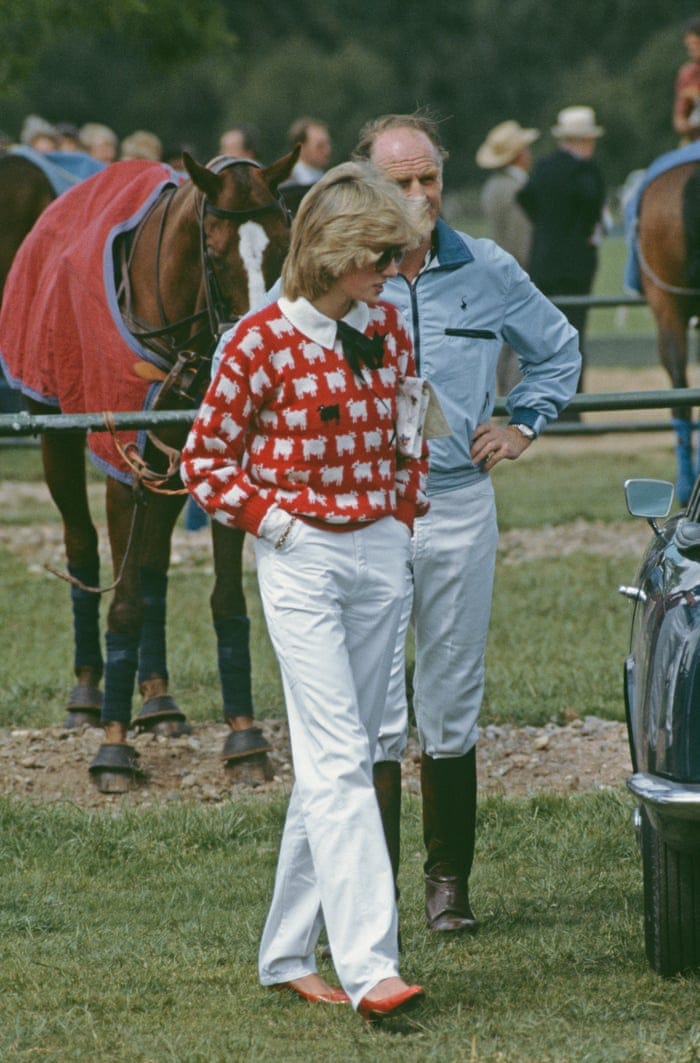
I am also now the proud owner of Princess Diana’s iconic sheep jumper.
I'm glad you read Brideshead!!! The show is also really good